Developmental Impact by Design
Design for impact. Learn as you deliver.
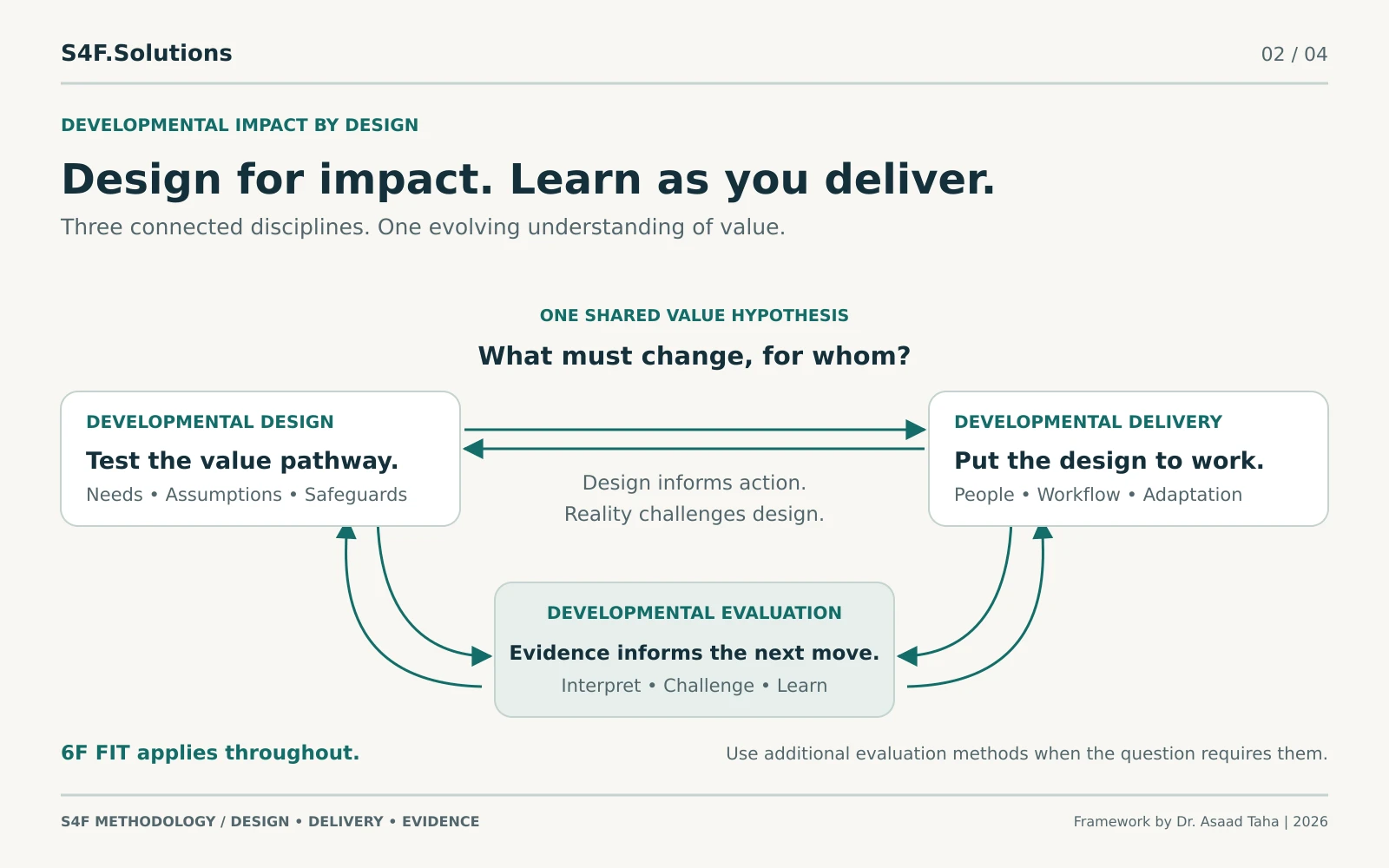
S4F connects the result that matters to the work, people and conditions expected to produce it. We test that connection during implementation and use the evidence to improve the next decision. Developmental means the design and delivery can improve as evidence, context and capability change. It does not mean unstructured experimentation.
Developmental design
We begin with the intended value and examine the system expected to produce it. Systems and ecosystem mapping reveal relationships, constraints, incentives, feedback and affected people. Human-centered design tests whether the change fits the people doing and experiencing the work. Foresight tests whether the design can withstand plausible change. The result is a causal value hypothesis and a bounded design space.
Developmental delivery
We translate the design into responsibilities, workable handoffs, skills, review procedures and a bounded test. Delivery evidence feeds back into the design. Where AI supports the work, human authority, exceptions and escalation are explicit.
Fit-for-purpose evaluation
Developmental evaluation supports emergent or rapidly changing work. Mature initiatives may require process, outcome, contribution, comparative, economic or causal evaluation. The method follows the decision, maturity and risk. Findings inform the next choice rather than becoming a report detached from delivery.
The operating vocabulary
Diagnose, Design, Prioritize, Enable, Deploy, Measure and Adapt describe the full cycle of capabilities. They do not prescribe a one-way buying sequence. An engagement may enter through a live design, delivery, evaluation or decision problem and validate the foundations already present.
Decision gates
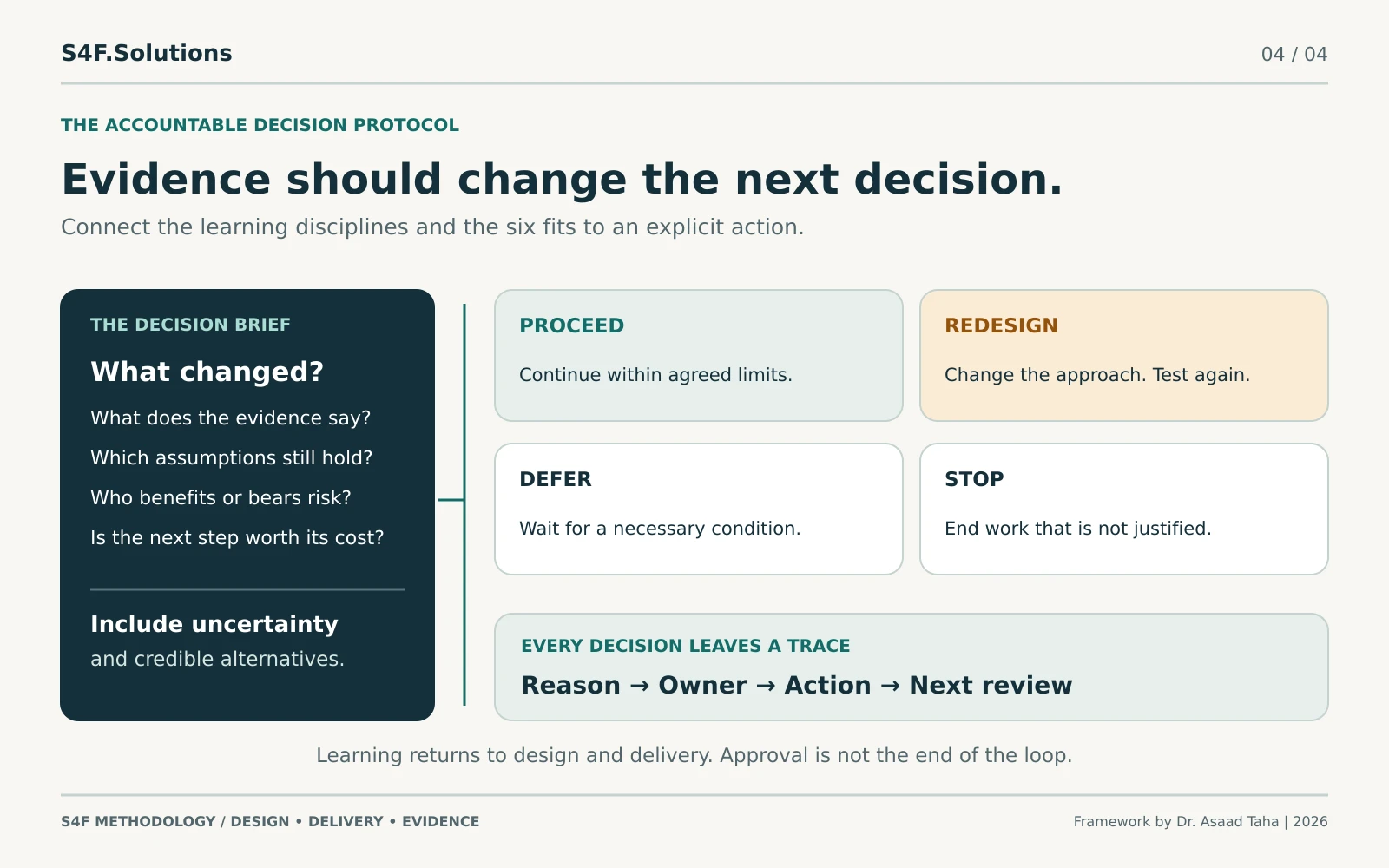
Proceed: continue within agreed boundaries. Redesign: change the pathway and test again. Defer: wait for a necessary condition. Stop: end work that is not justified.
Apply the method to a live challenge
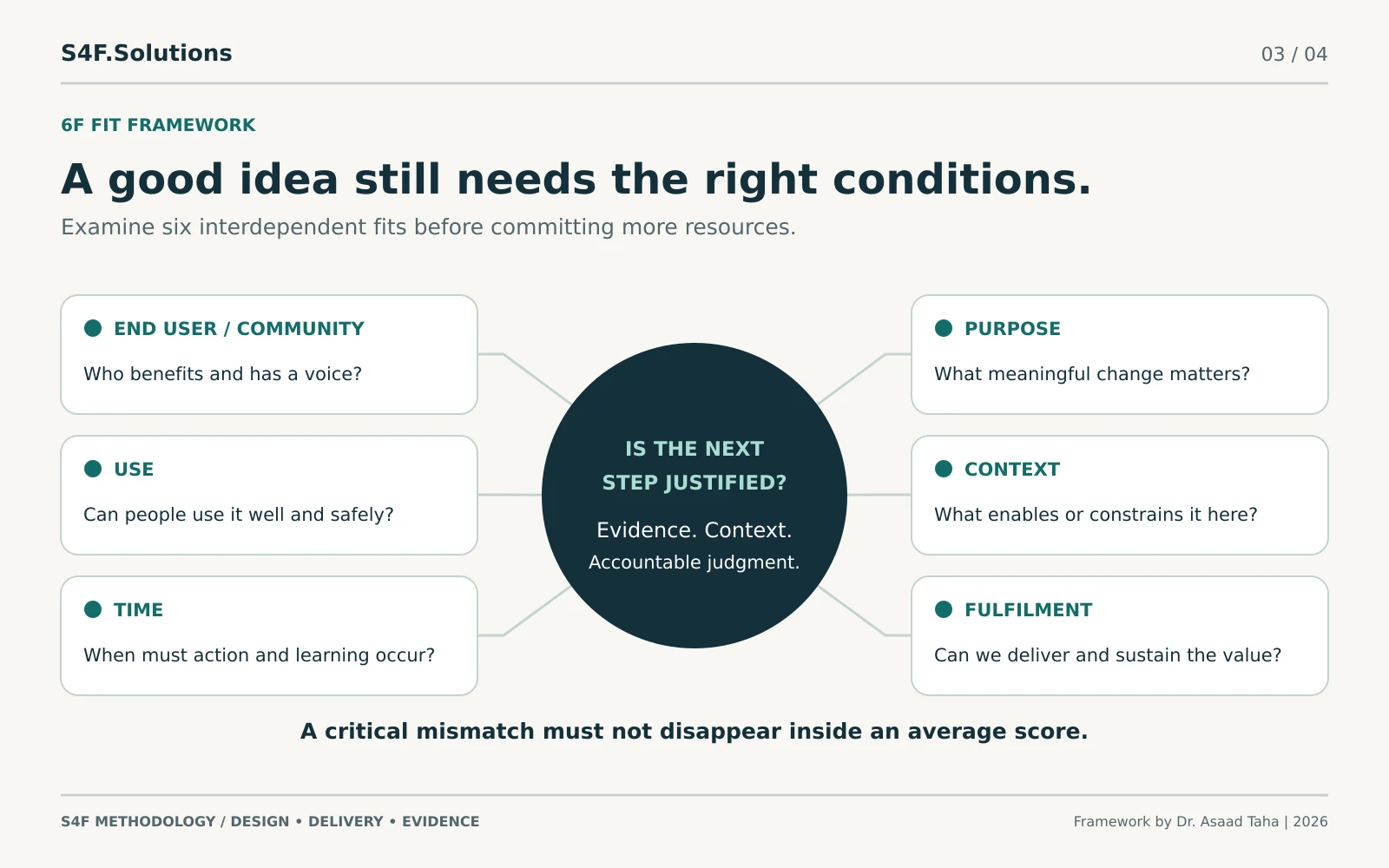
A good idea still needs the right conditions.
6F FIT tests whether a value pathway remains credible across six conditions. It is not a sequence, a generic maturity score or an average that allows a critical mismatch to disappear.
End User / Community
Who benefits, who bears risk, who has a voice and whose experience will determine whether the change works?
Purpose
What meaningful change matters, for whom, and what mechanism is expected to produce it?
Use
Can people use the intervention well, safely and consistently within the real workflow?
Context
What cultural, institutional, political, economic, technical or infrastructural conditions enable or constrain it?
Time
When must action, value and learning occur? Which delays or windows materially change the decision?
Fulfilment
Can the organization deliver, finance, govern, sustain and improve the value pathway?
Interpretation rule
A material failure in one fit cannot be hidden by strong scores elsewhere. The purpose is to expose the condition that must be addressed before proceeding, not to manufacture a favorable average.
Evidence is useful only when it changes a decision.
S4F maintains a clear line from source material to evidence, signal, confidence, causal interpretation, assumption, risk, leverage point, decision, action and learning. This decision-continuity discipline reduces institutional amnesia and prevents automated outputs from becoming unexamined authority.
Human authority
Accountable people retain authority for consequential decisions. AI may help organize evidence, surface alternatives or draft a brief, but it does not own the decision, the ethical judgment or the consequences.
Decision record
Each material decision should retain the reason, owner, action, boundary, evidence basis, uncertainty and next review.
Discuss a decision that needs continuing review